Table of Contents
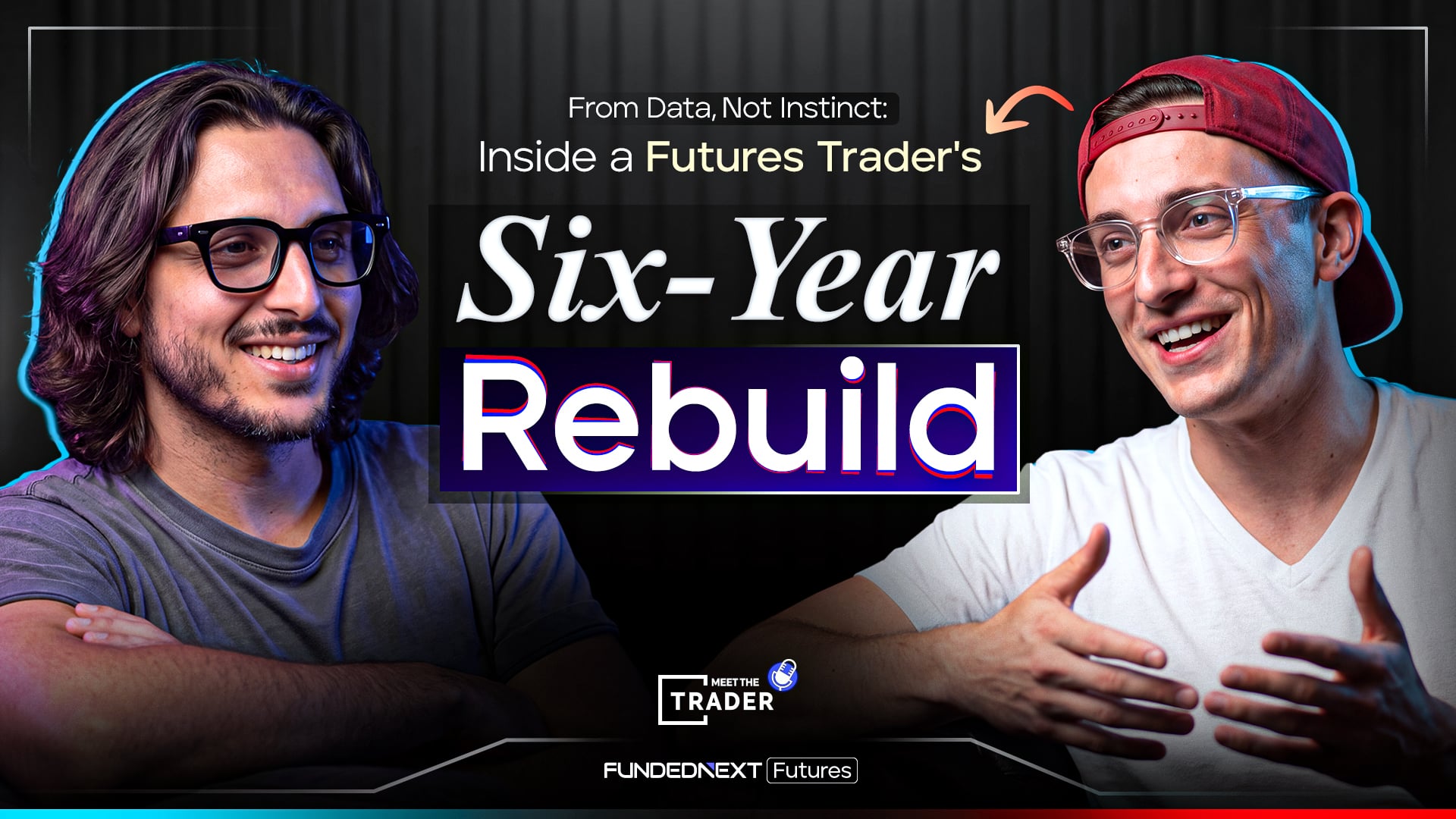
John didn’t start with a trading strategy. He started with a spreadsheet. A former data analyst who once worked as an interpreter in Shanghai, John began studying markets in 2020 with almost no background in trading itself. “I knew nothing about futures even,” he says in the first episode of FundedNext’s Meet the Trader series. “I just thought you could only buy a stock.”
That gap between technical skill and market knowledge shaped almost everything that followed, including a blown funded account, a slow rebuild through data, and eventually a full-time career trading NASDAQ futures from Bangkok.
Starting From Zero
Before trading, John worked at a video game company in China, translating content professionally. He found the subjectivity of that work frustrating. “With trading, it’s kind of concrete,” he explains. “Did you win or lose.”
During the pandemic, he studied Python and data science, then applied that statistical lens to markets. His first attempts were built on an analysis of stock volatility, an approach he now recognizes was shaped entirely by inexperience. He didn’t distinguish between currency pairs by volatility. He didn’t know what a lot was. “I thought one lot on gold was the same as one lot on EURUSD,” he says.
He passed his first prop firm challenge in 2022, trading a three-phase model he now advises against for statistical reasons. Then he blew the funded account trading from his phone, catching a major news event without realizing it. “I freaked out,” he says. “You should never blow a funded account.” The recovery took a deliberate month away from charts before he returned to data with a specific question: what actually went wrong.
Finding a System Through Renko Bars
Between 2021 and 2022, John built his approach around Renko bars and Ichimoku, eventually settling on a simplified structure: a 200-period moving average applied to a Renko chart. When price sits above the average and two red bricks form after a green one, he looks for a hold through the next brick, sometimes two, given how Renko bricks compress price movement.
The underlying logic matters more than the tool. “Time isn’t important in a sense of time for the candle,” John says. “You’re saying, I want to hold a trade for X bars, X ticks, X pips for profit.” He trades primarily NASDAQ and gold futures, favoring session opens and crossovers such as the Asia to London transition and the London to New York cross, where he finds directional clarity easiest to read.
He describes himself as a momentum trader rather than someone chasing reversals, taking one or two trades a day rather than reacting to every signal. Early on, he traded far more frequently. Narrowing to fewer, higher-quality signals came from reviewing his own data rather than following a rule someone else gave him.
Why FundedNext
John was introduced to FundedNext through European traders he met while living abroad in China and Taiwan, at a point when regulatory changes had limited access to certain platforms for American traders. Peers described slow payouts and poor spreads at other CFD prop firms he’d considered. When FundedNext launched a futures offering, the connection to a trusted brand made the decision straightforward.
“Got a few payouts,” he says. “Honestly, great experience. Can’t complain.”
His advice to newer traders reflects the same caution he applied to his own start: don’t purchase a challenge before you understand your own approach, and only risk what you’re comfortable losing on the attempt itself.
Risk, Sized as a Percentage
John sizes risk as a fixed percentage of account value rather than a fixed dollar or contract amount, then works backward to determine how many micro or mini contracts fit that percentage given a trade’s stop distance. A hypothetical two to four times the average true range sets his stop and target, and contract size follows from there.
He also separates his approach by account stage. During a challenge, he accepts more drawdown because the goal is qualifying for a funded account. Once funded, he trades with less risk, prioritizing keeping the account and generating payouts over maximizing challenge-phase speed.
Psychology, After the Data
John is direct about where he places trading psychology in the hierarchy of what actually drives results. “A lot of people say, oh, I’m not profitable because of my psychology,” he says. “Respectfully, you haven’t back tested, you haven’t journaled, you don’t have a profitable strategy.” In his view, confidence follows from proof, not the other way around.
That doesn’t mean the mental side is absent. He describes the difficulty of watching a two thousand dollar profit shrink toward a five hundred dollar drawdown before recovering, and the discipline required to stay within a strategy’s known range of outcomes rather than reacting to any single losing streak. Getting to a place where a red day doesn’t dictate the next day’s decisions took roughly two years, he says, and he has since coached another trader through the same process over six months.
He also points to a cultural shift: moving from the American Midwest, where he felt pressure to project success, to life in Bangkok, where he found more space to treat both wins and losses with proportion. A strong month doesn’t guarantee the next one will look the same, and he treats that as a fact to plan around rather than a threat to his confidence.
Advice for Traders Starting Out
Asked what he’d tell someone new to futures trading, John narrows it to three points. Trade one instrument, either NQ or ES, rather than spreading attention across multiple markets. Build a strategy around a VWAP bounce as a starting structure. And take every signal on a demo account while journaling a prediction and a reason before the outcome is known.
The instrument choice matters less for its own sake than for what focus enables. “The more you learn, the more you’re going to question yourself,” he says, paraphrasing a well-known idea about depth over breadth in skill building. Narrowing to one market let him gather enough repeated data to actually trust his own read of it.
Life Outside the Charts
John’s routine centers on structure without excess. Mornings begin with a swim rather than meditation, then a review of the previous day’s trades, timed a full day later so the read stays objective. He watches for a signal around the New York open, generally entering shortly after the first fifteen minute candle prints, and keeps a small side income teaching English and Chinese.
His long-term goal isn’t a specific monthly figure. He describes wanting roughly $800,000 set aside, enough that even if his current approach stopped working, a standard investment fund could support the life he wants: being present for a future family, staying near the community of traders he’s found in Bangkok, and continuing to live abroad rather than returning to the United States full time.
Watch The Full Story
This only covers the highlights. John also gets into why he swims instead of meditating, what a two dollar meal prep looks like in Bangkok, and the Bruce Lee quote that shaped how he decided to trade just one market instead of ten. Catch the full conversation on episode one of FundedNext’s Meet the Trader, season 2.